LECTURE NOTES
YOU ARE ONLY RESPONSIBLE OF LIGHT AND COLOR FOR THE FINAL EXAM!!!!!!!
/uploads/files/INAR121%20designelements4%20LIGHTa%202014-15.ppt
/uploads/files/INAR121%20designelements4%20LIGHTb%202014-15.ppt
/uploads/files/INAR%20121designelements4%20LIGHTc%202014-15.ppt
/uploads/files/COLOR%20AND%20COLOR%20PSYCHOLOGY%202015.pptx
YOU ARE NOT RESPONSIBLE FOR THE OTHER SUBJECTS IN THE FINAL EXAM!
DESIGN:
The term describes all of the decisions that determine how a particular object, space, or building will be. It includes most purposeful changes to the physical environment. Design can also be described as determination of ‘form’. Form is understood to mean every aspect of every quality, including size, shape, material, structure, texture, and color, that makes one particular physical reality different from any other. For example, when we speak of a house, an office, chair, or vehicle, we refer to certain general characteristics, and the useful purposes they serve; but nothing of the specifics that make them unique, different, special. It is the ‘design’ differences that make them different, so that we can compare them as better or worse.
Designers represent a variety of approaches and aesthetic attitudes. But
they share an understanding at some basic level of what a good design is:
A Good Design Satisfies 3 Essential Criteria:
1. It works well, serving the needs and requirements of its users,
2. It is well made of good and appropriate materials,
3. It is aesthetically successful.
So basically, when we analyze and evaluate a design, we view it in terms of
three qualities:
1. FUNCTION
2. STRUCTURE AND MATERIALS
3. AESTHETICS
ARCHITECTURE:
Taking the concept of design, we can move on to Architecture. It has been said that design is the purposeful changes made to the environment, architecture is therefore any construction that deliberately changes the physical environment according to some ordering system. By order we mean classification, organization and differentiation.
PURPOSES OF ARCHITECTURE:
- Architecture provides settings for certain activities such as sports, education, leisure activities etc.
- It reminds people of what certain activities are, for example, eating, studying, etc.
- It signifies power, status, or privacy as in government buildings, or wealth and richness as in residential buildings.
- It expresses and supports beliefs, as mosques and churches do.
- It communicates information. For instance, we can talk about the time a building was built by looking at the types of materials used, or the style of the elements used such as columns, or talk about the climate, thickness of the walls, etc.
- It helps establish individual or group identity. Home vs.
classroom, studios.
- And it encodes value systems. Building types are differ among different cultures. For example Japanese housing is different than Turkish housing)
ARCHITECT:
An architect is a person trained in basic building construction, and designs buildings from the foundation up. In many cases, the architects’ design includes many interior elements such as room shapes, door and window locations, details and selection of materials, and elements such as lighting, heating, air conditioning, plumbing and related fixtures. Note that you will be hearing the abbreviation HVAC many times in this profession.
INTERIOR ARCHITECTURE:
We all know how important it is to create spaces that are comfortable, organized, convenient, and pleasant. Therefore Interior architecture describes a group of related projects that are involved in making any interior space into an effective setting for all human activities that take place. Interior architecture is an exploration of the whole spectrum of architecture necessary for human accommodation, comfort, and delight. It focuses on the humanistically conceived space and seeks to synthesize the parallel development of architects, interior designers, and artists. Interior architecture is a combination of all these disciplines.
INTERIOR ARCHITECT:
An interior architect is a designer who deals with the basic arrangement of spaces, room arrangements, and manages technical issues such as lighting and acoustics, taking into consideration aesthetic values, and social and emotional needs of the users.
The Interior Architect:
A professional Interior Architect is a person, qualified by education, experience, and recognized skills, who
- identifies, researches, and creatively solves problems pertaining to the function and quality of the interior environment;
- performs services relative to interior spaces including programming, design analyses, space planning, aesthetics, and inspection of work on site, using specialized knowledge of interior construction, building systems and components, building regulations, equipment, materials, and furnishings;
- and prepares drawings and documents relative to the design of interior space,
in order to enhance the quality of life and protect the health, safety, and welfare of the public.
ELEMENTS OF DESIGN:
The relationship among the elements of a design give it individuality. In order to look at a design as a whole, we must consider the pattern or interrelationship among them. We should be conscious of the visual characteristics of things and how they relate to aesthetic quality of our environment. Each of these elements contribute to the overall design and its effect.
DESIGN ELEMENTS:
1. LINE
2. FORM
3. SHAPE
4. TEXTURE
5. PATTERN
6. COLOR
7. LIGHT
8. SCALE
9. SPACE
POINT: Is the generator of all forms. It is static and directionless. When point moves it makes a LINE.
A LINE CAN BE IMPLIED BY:
I) POINTS
II) II) SIMILAR ELEMENTS IF CONTINIOUS
III) III) TEXTURE QUALITIES
HORIZONTAL LINES REPRESENT:
1. Stability
2. Strength
3. Plane upon which we stand or move
VERTICAL LINES REPRESENT:
State of equilibrium with force of gravity.
DIAGONAL LINES REPRESENT:
1. Rising and Falling
2. Movement
3. Active and Dynamic
CURVED LINES REPRESENT:
1. Movement deflected by lateral forces
2. Gentle movement
3. Uplifting or solidity and attachment to earth
4. Small curves can express playfulness, energy, or pattern of biological growth.
WITHOUT LINE THERE IS NO DEFINITION OF SHAPE.
LINE IS ESSENTIAL IN THE FORMATION OF ANY VISUAL CONSTRUCTION.
LINES ARTICULATE EDGES OF PLANES AND CORNERS OF VOLUMES.
LINES CREATE TEXTURE AND PATTERN
A composition with too much of any one type of LINE may become uninteresting or unpleasant; but emphasizing one type promotes them.
PLANE has 2 dimensions: WIDTH & LENGTH but has NO DEPTH
PLANAR FORM QUALITIES:
I) MATERIAL
II) COLOR
III) TEXTURE
IV) PATTERN
PLANAR FORMS ARE FUNDAMENTAL ELEMENTS OF ARCHITECTURE
VOLUME: Is a plane extended in a direction other than along its surface
Volume can be either SOLID or VOID
SOLID: Space displayed by MASS
VOID: Space enclosed by planar forms
FORM: Describes the contour and overall structure of a volume
Visible form gives space:
I) DIMENSION
II) SCALE
III) COLOR
IV) TEXTURE
SHAPE: Is the primary means by which we distinguish one form from another
SHAPE refers to:
I) The contour of a line
II)The outline of a shape
III)The boundary of a 3 dimensional shape
3 BASIC GEOMETRIC SHAPES ARE
I) CIRCLE
II) SQUARE
III) TRIANGLE
WHEN EXTENDED INTO 3-D, THE PRIMARY SHAPES GENERATE
SPHERE
CYLINDER
PYRAMID CONE
CUBE
CIRCLE: Is a compact shape, it is introverted, the centerpoint represents:
I)UNITY
II)CONTINUITY
III)ECONOMY OF FORM
TRIANGLE: Represents stability
I)It is stable, resting on one of its sides
II)When tipped to stand on one of its points, it becomes DYNAMIC
TRIANGLES COMBINE TO FORM POLYGONAL SHAPES
SQUARE: Represents the pure rational equality of its sides, they express REGULARITY and VISUAL CLARITY
I)It is stable, resting on one side, no direction
II)Standing on one corner, it becomes DYNAMIC
A rectangle is a variation of a square with the addition of: WIDTH & LENGTH
VARIETY to rectangle is achieved by:
1. SIZE
4. TEXTURE
3. COLOR
2. PROPORTION
5.PLACEMENT
6. ORIENTATION
IN DESIGN WE PREFER RECTANGULAR SHAPES BECAUSE THEY ARE:
I)EASILY MEASURED
II)EASILY DRAWN
III)EASILY MANUFACTURED
IV)FIT WELL IN CONSTRUCTION
TEXTURE: Refers to the quality of a surface because of its 3-D structure
Texture describes:
I) Smoothness or roughness of a surface
II) The characteristic surface qualities of familiar materials such as stone, wood, fabric
2 BASIC TYPES OF TEXTURE:
TACTILE: felt by touching
VISUAL: seen by eye
Light is not what we see, but what we see by. Exactly what we perceive depends upon the kind and quality of light available. The light bouncing off objects reflects back to the eye variations of brightness and color that correspond in a complex geometric way with the size, shape, distance, color and texture of those objects.
NATURAL LIGHT:
THE SUN IS THE OLDEST SOURCE OF LIGHT KNOWN TO US. ITS RADIATION NOT ONLY PERMITS US TO SEE, BUT ALSO ALLOWS THE LIFE-SUPPORTING PROCESSES TO TAKE PLACE. ROOMS THAT ARE ILLUMINATED BY SUNLIGHT HAVE A VITALITY ABOUT THEM.
Daylight is highly variable, its angle and brightness changes over the course of the day and the year, and with fluctuations in the weather. Because natural light is both horizontal as well as vertical, it helps define the changing contours and textures of surfaces. It also provides light from the entire light spectrum–even those frequencies that we cannot perceive with our eyes. Some lighting experts argue that the qualities of daylight are essential to a sense of well-being in people, and that lack of daylight leads to boredom, fatigue, lack of concentration, and even a reduction of intellectual capacity.
ORIENTATION
EAST: East-facing openings admit strong sunlight early in the morning and lose the sun sometime before noon. BEDROOMS, KITCHENS, BREAKFAST AREAS, AREAS USED EARLY IN THE DAY
WEST: West-facing windows receive the late afternoon sun, which is sometimes too much direct daylight on summer afternoons, or in climates with many days of strong sunlight. WESTERN EXPOSURE CAN CREATE UNCOMFORTABLE GLARE AND HEAT IN SOME PARTS OF THE COUNTRY. SHADING DEVICES SUCH AS OVERHANGS OR BLINDS CAN PREVENT PROBLEMS CAUSED BY THE HARSHNESS OF DIRECT SUNLIGHT
NORTH: Openings facing north, which never admit direct sun, generally receive cool but consistent light from the north sky. ARTISTS’ STUDIOS, DESIGNERS WORKSHOPS, THEY SHOULD NOT HAVE A WIDE VARIATION OF ILLUMINATION
SOUTH: Good orientation, ideally facing south with appropriate shading, makes a difference in winter and summer. FAMILY ROOMS, LIVING ROOMS, SEWING ROOMS
WE CAN USE DECIDUOUS TREES ON SOUTH SIDE TO PREVENT HEAT AND GLARE.
CONIFEROUS TREES GIVE A GARDEN GUARANTEED COLOUR ALL YEAR ROUND; WHEN PLANTED ON THE NORTH SIDE, THEY CAN BLOCK SOME OF THE PIERCING NORTHERN WINDS IN THE COLDER MONTHS OF THE YEAR.
Finishes. The color and reflectivity of interior finishes are important in use of daylight and control of luminous ratios. Light colored surfaces enlarge the perception of space and diffuse the light distribution. The ceiling is the most effective surface for reflecting light and typically, it should be very light in color. The floor is one of the least significant, and it is here that the designer has the greatest opportunity for the use of darker colors, such as those found in carpets
Shading Devices. Louvers, overhangs, shades, blinds (with or without draperies), or other devices can be applied creatively to control the excessive illumination and luminance contrast emitted from the sun. This is critical when eyes that are concentrating on an interior task can view the light source. In such cases, the window or skylight should be filtered or shielded from view, or the task should be oriented away from these sources.
Furniture Placement. When placing furniture, it is important to keep bright windows out of the field of vision of any person doing close up tasks like reading or repair work. Seated people who are doing visual tasks with their backs to a window can cause problems because of the shadow cast forward on to the work plane. The traditional advice of “light over the left shoulder” is still good, although light from the right is also satisfactory for most tasks and ideal for left-handed people.
Multiple Glazing. Multiple glazing uses two, sometimes three, sheets of glass that are factory-assembled into a sandwich. The dead air spaces between the layers minimize winter heat loss or summer heat gain. Special
glass tinted to filter out unwanted heat energy while permitting most light to pass through can also be obtained.
ARTIFICIAL LIGHT:
Good lighting supports convenience, efficiency, comfort, safety and favorable emotional reactions. It has been shown that improving the lighting of a space can be more effective than any other single factor in increasing the overall sense of satisfaction. Just switching off a glaring ceiling fixture and substituting a well-placed task lamp can make a dramatic improvement, often at very little cost.
PROPER AMOUNT AND TYPE OF LIGHT ADDS BEAUTY TO THE COLORS AND FURNISHING OF SPACES. EXCESS BRIGHTNESS DISTURBS THE EYE, IT SHOULD BE CONTROLLED.
LIGHT IS MEASURED IN FOOT CANDLES
GOOD LIGHTING:
CAN INCREASE EFFICIENCY: Direct or concentrate attention. Lighting draws attention to points of interest and helps guide users through space by influencing the timing and direction of their gaze. A brightly-lit wall or spotlight clearly displays artwork, and draws the viewer to it. A good light at a desk, with the surroundings at a lower light level, helps to concentrate attention on work.
RELEIVES EYE STRAIN
CUTS DOWN ON ACCIDENTS: Proper lighting can enhance visibility and engender a feeling of safety; it also can be used to illuminate potential hazards, such as a change in floor plane or a moving object.
HELPS SET THE MOOD/ATMOSPHERE OF A SPACE: Dim light usually makes a space seem intimate and cozy; bright light, more business-like and energetic.
CAN GIVE CHARACTER: Every designer needs to have a basic understanding of lighting mechanics in order to deal with design issues directly, as well as to work effectively with engineers or lighting specialists when they are involved in a project
WHEN LIGHT HITS A SURFACE:
ANGLE OF INCIDENCE (a) IS EQUAL TO ANGLE OF REFLECTION (b)
a = b
DIFFUSED LIGHT: IS LIGHT REFLECTED THROUGH GLASS OR PLASTIC. FROSTED BULB PROVIDES BETTER QUALITY LIGHT THAN CLEAR BULB.
GLARE: IF THERE IS LUMINANCE DIFFERENCE BETWEEN 2 OBJECTS, SURFACES, GLARE WILL OCCUR.
TYPES OF GLARE:
Direct glare Glare resulting from an unshielded source
Disability glare Glare resulting in reduced visual performance and visibility
Discomfort glare Glare producing discomfort but not necessarily impairing visual performance or visibility
3 MAJOR TYPES OF ARTIFICIAL LIGHT SOURCES:
• INCANDESCENT
• FLUORESCENT
• HIGH INTENSITY DISCHARGE (HID) AND COLD CATHODE
INCANDESCENT LIGHT:
THE LIGHT IS PRODUCED FROM THE HEATING OF THE “TUNGSTEN FILAMENT” INSIDE THE LIGHT BULB WITH AN ELECTRIC CURRENT UNTIL IT GLOWS.
*SIZES VARY FROM 15 WATTS TO 200 WATTS
*BULBS ARE AVAILABLE IN BLUE, PINK, YELLOW, GREEN.
*SHAPES AND FINISHES VARY
ADVANTAGES: IT IS LESS EXPENSIVE , MORE FLEXIBLE, EASY TO CHANGE, MAY BE RECYCLED INTO CERAMIC TILES
DISADVANTAGE: IT TAKES MORE ENERGY AND GENERATES MORE HEAT THAN FLUORESCENT LIGHT.
TUNGSTEN HALOGEN LAMP
A Tungsten Halogen Lamp is a type incandescent lamp with a tungsten filament contained within an inert gas and a small amount of a halogen such as iodine or bromine.
The filament of the small lamp is surrounded with halogen gas. As the tungsten burns off, the halogen reacts with the tungsten (called Halogen Cycle), creating a bright light.
Advantages and Disadvantages: Tungsten halogen costs more than common incandescent lighting but last three times longer, burn 10 percent brighter, and are closer to the natural spectrum. But produce more heat.
FLUORESCENT LIGHT:
THE TUBE IS FILLED WITH VERY LOW PRESSURE MERCURY VAPOR (OR XENON) AND A SPECIAL POWDER COAT INSIDE THE TUBE. WHEN THE CATHODES AT EACH END OF THE TUBE ACTIVATE THE VAPOR, THEY CAUSE THE FLUORESCENT COATING TO PRODUCE LIGHT.
SHAPES AVAILABLE: STRAIGHT, TUBULAR, CIRCULAR, U SHAPED
ADVANTAGES: IT LASTS LONGER, PRODUCES LESS GLARE, LESS HEAT, COSTS LESS.
DISADVANTAGE: COLOR QUALITY. DIFFICULT TO MAINTAIN.
Fluorescent light is a relatively shadowless, even light, making it ideal for general lighting of environments where tasks are performed but where task lighting would be impractical or undesirable.
They are commonly used in luminous ceiling panels, under-the-cabinet lighting over the counters, in bathroom lighting and over work surfaces in offices.
With this type of light, work can take place for hours without lighting-caused fatigue.
COMPACT FLOURESCENT LAMPS
These are initially more expensive , yet they consume almost one-fifth of the power and last up to sixteen times longer than incandescent lamps. Basically, CFLs use less power and have a longer rated life.
METAMERISM:
1. SAME MATERIAL LOOKS DIFFERENT UNDER DAYLIGHT AND ARTIFICIAL LIGHT
2. TWO MATERIALS LOOK ALIKE UNDER DAYLIGHT, BUT DIFFERENT UNDER ARTIFICIAL LIGHT
HIGH INTENSITY DISCHARGE (HID):
High Intensity Discharge (HID) HID lighting combines some of the advantages of incandescent and fluorescent. The lamps give point or near-point light; they are cheap and efficient to run, have a very long life, and some types (especially when used in combination) have good color characteristics. On the other hand, there is a high initial cost for both the lamp and the specialized fixture, and they require a bulky and expensive transformer. There are several types of readily available HID lamps:
LIGHT IS PRODUCED BY DISCHARGING ELECTRIC CURRENT THROUGH HIGH PRESSURE VAPOR
HID is used for bright interior and exterior lighting. HID lamps establish an arc between two vey close electrodes set in opposite ends of small, sealed, transclusent or transparent glass tubes.
HID lamps are used to “uplight” exteriors of large buildings and sometimes in interiors of nonresidential buildings.
Neon. These tubes are familiar to us in illuminated signs, are available in a full range of colors, including whites. Neon tube life is very long (several years); it is limited by low efficiency, and usually considered for special, decorative applications.
– Cold Cathode. This type is very similar to neon, and is sometimes useful in situations such as indirect lighting coves of irregular shape.
– Fiber Optics. Strands of glass fibers, usually bundled, can convey light from any source to one or more remote locations, where the light then emerges from the fibers. Various experimental applications are under development, but the only uses available in interior design are decorative.
– Laser Light. This is a process in which light is concentrated and emitted in an intense beam. Although laser light can be used in decorative and display functions, it does not yet have extensive practical application.
TYPES OF LIGHTING DEVICES
All lighting devices fall into one of two mounting types: architectural or portable. Architectural lighting is fixed by building in or attaching fixtures to the structure of the building. Fixtures are often recessed, and more or less concealed. Correct architectural lighting is planned and is installed as a space is built or renovated. Portable lighting includes lamps and other moveable lighting devices that are plugged into outlets and can be moved about or replaced at will.
Types of Floor, Table, Desk and Specialty Lamps
Shaded Lamps. This is probably the most familiar and useful, portable fixture type. The bulb or bulbs are surrounded by a shade,which reduces glare but disperses direct light up, down or both. They can be fitted with incandescent or the new compact fluorescent lamps for energy efficiency. Because such lamps deliver excellent lighting, they are often selected as task lamps to illuminate small areas in offices and residences.
Reflector Lamps. These enclose a regular or reflector bulb, either incandescent or halogen, in an opaque reflector that directs light in one direction. They make good reading or work lights but can produce excessive brightness contrast unless fill light is provided from another source. The most familiar version is the cantilever, adjustable neck reflectors that are used as desk lamps. They have become a popular, inexpensive solution to many home and office lighting problems.
Globe Lamps.
In these, glass replaces the shade; this reduces the brightness of the enclosed incandescent lamp, and delivers diffused light. Globes are made of clear, frosted, smoked, or colored glass, and the fixtures are either wall-mounted or chandelier. Globe lamps tend to form a spot of glare and deliver unattractive, flat lighting.
Uplights and Torchieres. These are usually floor lamps that aim all light output upward to use the ceiling plane as a reflector, providing indirect, general lighting. The source light is usually incandescent, but halogen and HID versions are becoming increasingly popular.
POINTS TO BE CONSIDERED WHEN CHOOSING A LAMP:
SHOULD BE STABLE AND WELL BALANCED
DIFFUSED LIGHT GIVES LESS GLARE
LAMP SHADES SHOULD BE SIMILAR IN COLOR, TEXTURE, OR
CONTRAST
HEIGHT COULD BE ADJUSTABLE OR TILTABLE
A FLOOR LAMP SHOULD BE PLACED SO THAT LIGHT COMES FROM BEHIND THE SHOULDER OF THE READER. LEFT OR RIGHT, BUT NOT DIRECTLY BEHIND THE READER.
FOR READING PURPOSES:
LOWER EDGE OF SHADE SHOULD BE ABOUT 1 M FROM FLOOR FOR TABLE LAMP
LOWER EDGE OF SHADE SHOULD BE ABOUT 1.20 M – 1.25 M FROM FLOOR FOR FLOOR LAMP
• Cove Lighting. Lighting by means of sources shielded by a ledge or horizontal recess that distributes light over the ceiling and upper wall. This system requires a cove, or pocket, to be built into the ceiling or wall. The light units, typically fluorescent or cold cathode, are concealed from view and provide indirect light.
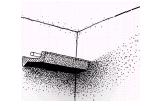
{C}• {C}cornice lighting Lighting by means of light sources shielded by a panel parallel to the wall and attached to the ceiling
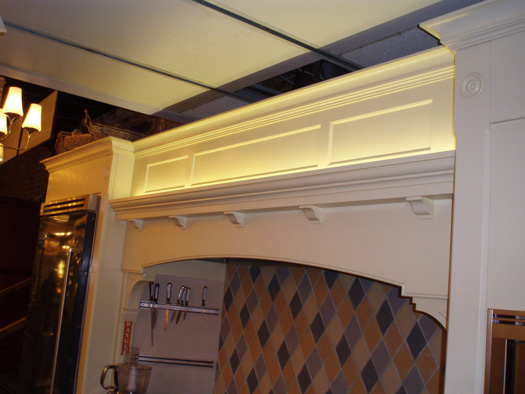
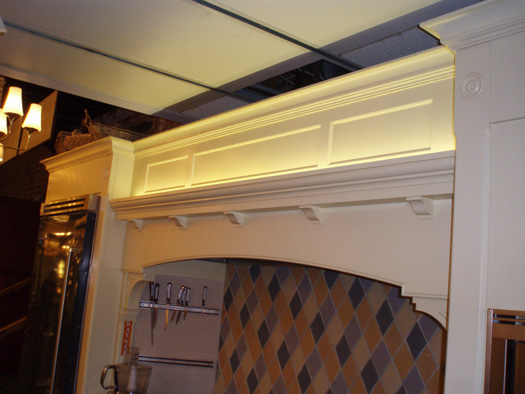
{C}• {C}soffit lighting The underside of a structural component, such as a beam, arch, staircase, or cornice.A light built into a soffit.
{C}• 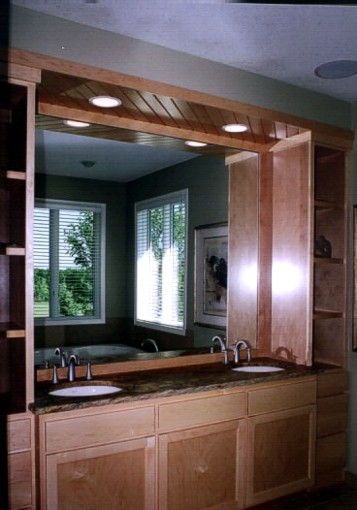
{C}• {C}valance Longitudinal shielding member mounted across the top of a window or high on a wall to conceal light sources
{C}• 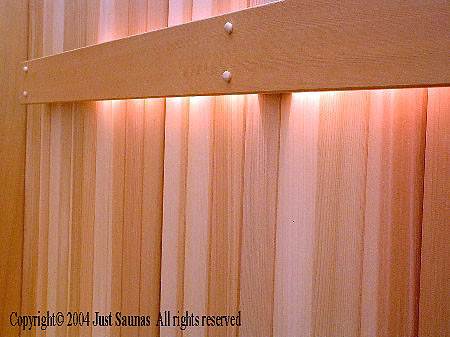
{C}• {C}POINTS TO BE CONSIDERED WHEN CHOOSING A FIXTURE:
{C}• {C}ADJUSTABILITY, MULTIFUNCTIONALITY (DIMMER CONTROL, HEIGHT, SWING)
{C}• {C}DIFFUSED LIGHT IS MORE PLEASANT, EXPOSED BULB IS IRRITATING
{C}• {C}DESIGN OF A FIXTURE SHOULD BE IN HARMONY WITH THE CHARACTER OF THE SPACE


TYPES OF LIGHT DISTRIBUTION:
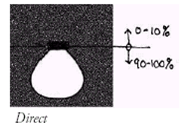
DIRECT: SHARPEST CONTRAST BETWEEN LIGHT AND DARK. USED TO EMPHASIZE OBJECTS
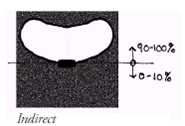
INDIRECT: SOURCE IS HIDDEN, LIGHT IS DIRECTED TO CEILING, A COVE OR ANOTHER SURFACE FROM WHICH IT IS REFLECTED.
.png)
DIRECT – INDIRECT: LIGHT IS DISTRIBUTED EVENLY IN ALL DIRECTIONS. THE FIXTURE HAS A BULB ON BOTH SIDES,INSIDE AND OUTSIDE THE REFLECTOR.
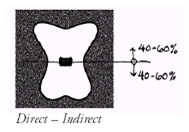
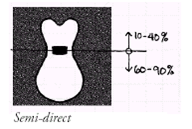
{C}• SEMI DIRECT:MORE LIGHT IS DIRECTED TOWARDS WORK PLANE
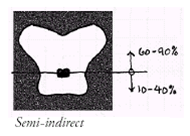
{C}• SEMI INDIRECT: MORE LIGHT IS DIRECTED TOWARDS CEILING OR UPPER WALL
METHODS OF ILLUMINATING SPACE:
{C}• {C}AMBIENT / GENERAL LIGHTING: The overall level of light in a space: COVE, VALANCE, CORNICE, SOFFIT, PANEL LIGHTING
{C}• LOCAL: PORTABLE LAMPS AND FIXTURE
{C}• ACCENT LIGHTING: Directional lighting to emphasize a particular object or draw attention to a part of the field of view (SPOT LIGHTING THAT EMPHASIZE THE CENTER OF INTEREST)
3 ASPECTS OF LIGHTING:
- FUNCTION: QUALITY AND QUANTITY IS IMPORTANT
{C}• READING/WRITING, SHAVING, MAKE-UP
- SAFETY: CERTAIN SPACES NEED MORE CARE
{C}• STAIRWAY, PATIO, DOORWAY, DRIVEWAY
- BEAUTY: GOOD LIGHTING MAKES INTERIOR LAYOUT MORE BEAUTIFUL
LIGHT AFFECTS PEOPLES:
{C}• MOOD OR EMOTION
{C}• PRODUCTIVITY
{C}• AWARENESS
{C}• Several general design strategies can be used to update the thinking on how lighting and energy are used.
• Keep it Low. Contrary to the older school of thinking, working in adequate yet dim light will not harm the eyes, anymore than listening to music at lower volumes will hurt the ears. Brighter light is not necessarily better.
Uniform Overhead Fixtures Cannot Provide the Only Source of Light. This is especially true for offices now that computers are the focus of many peoples jobs. Additional and appropriate lighting should accompany each individual task in a work area.
Make Lighting Specific. Tasks need to be identified carefully and lighting chosen for each based on the task itself. It is important to take into consideration the task’s size, importance, the duration of time it needs to be performed, its priority in relation to other tasks, general lighting in the area, and the physical condition, age, and expectations of the person performing the task.
Let the User Control Lighting Options Whenever Practical. Because comfort factors will vary dramatically from task to task and person to person, the best task light is one that gives the user the most control over position and intensity. It is also important for the same person to be able to alter light levels to match his or her changing needs over the course of the day or season.
Consider the fixtures as a design element. Select fixtures that complement the over-all design objective. They should be a compatible scale, color, finish and geometry. Plan placement so that it coordinates with the structure from every view, and does not destroy the harmony of the design.
Prepare for the Aging Population. As people’s eyes age, the lenses grow larger and more rigid, requiring more effort for the eye muscles to focus at close range.
As a result, low light makes it harder to see clearly, color identification is decreased, and intolerance for both direct and reflected glare increases.
All these vision changes and their accompanying lighting needs will increase the challenge for the designer as our population ages.
FINAL EXAM (8.1.2013) WILL BEGIN AT 10:00 am!!!!!!!!!!
IFI DFIE INTERIORS DECLARATION